I have to tell you something that many in your network might disagree with, but it needs to be said out loud, and the sooner the better.
Your LinkedIn profile probably has a clean format, strong verbs, it’s showcasing this historical melody of your solid track record, all laid out in a way that would make any resume write proud.
And in the age of AI and what’s next happening, it is almost certainly costing you opportunities Not because it’s bad, but because it is answering the wrong questions entirely.
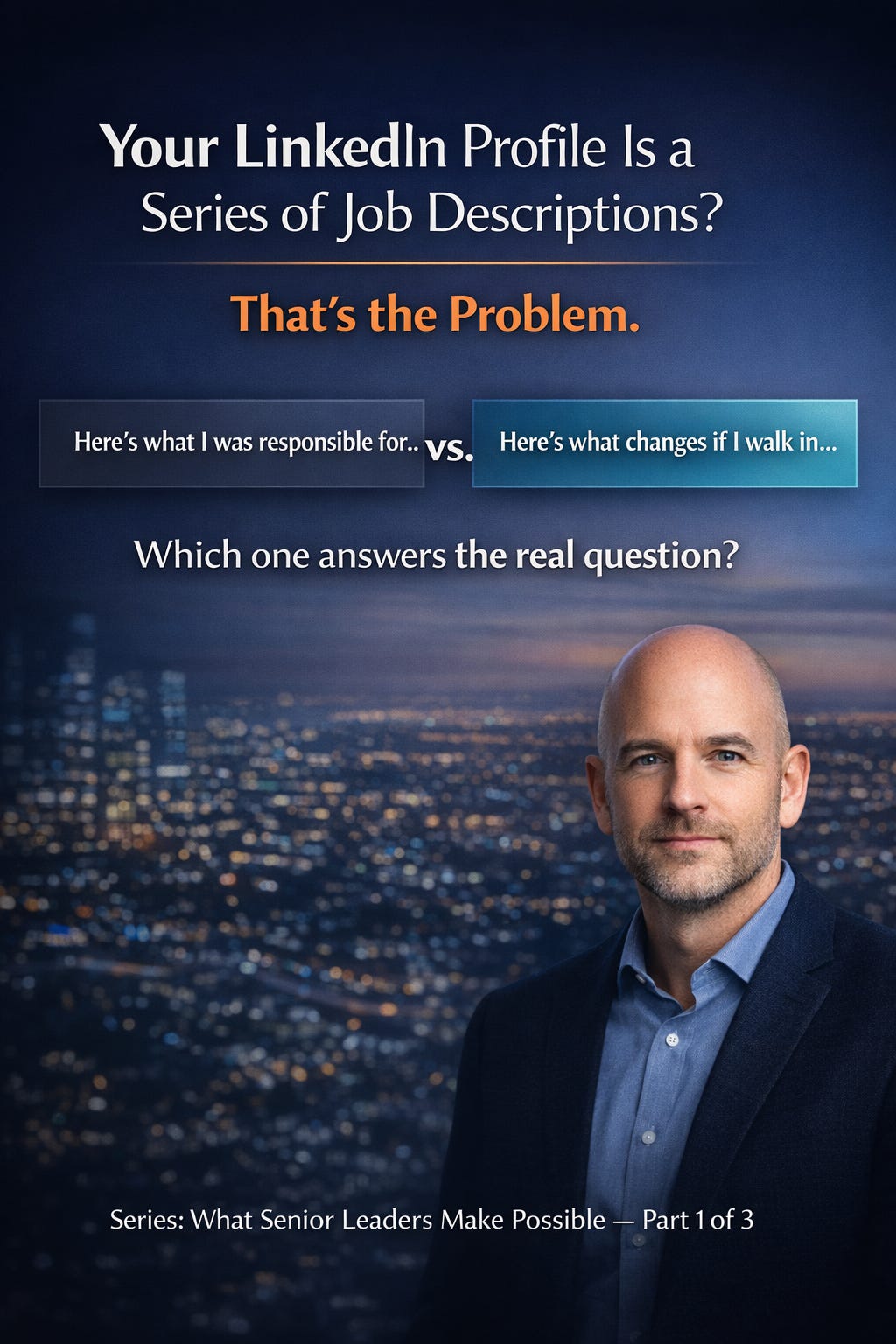
Here is what most senior profiles answer, underneath all the polished language:
Here is what I was responsible for.
And guess, what…this is that decision-maker actually needs to know:
If we bring this person in, what changes?
Those are not the same question. And the gap between them is where conversations stall, the callbacks that you worked really hard on all disappear, and talented people end up wondering why the market is not responding the way their career history says it should.
The language that built your career is working against you
Responsible for. Led. Oversaw. Delivered. Managed a team of.
That language made sense when experience alone carried weight. When decision-makers had the time and patience to read between the lines and connect the dots themselves. When a long title at a recognizable company was enough to move you to the top of the pile. That world is shrinking fast.
AI has changed the screening process at every level. Hiring teams are moving faster, comparing more candidates in less time, and making elimination decisions in seconds. You are not getting the benefit of the doubt anymore. You are getting ninety seconds, maybe, before someone decides whether your story is clear enough to pursue or easy enough to pass on.
And if your profile reads like a history of your responsibilities, you are asking busy, discerning, time-compressed decision-makers to do interpretive work that most of them simply will not do.
Senior decision-makers are not short on qualified candidates. They are short on certainty.
They are sitting across from a list of accomplished people and trying to answer four questions that most profiles never address:
If we bring this person in, what specifically changes?
What gets easier that is hard right now?
What accelerates?
What risk comes off the table?
These are not soft questions. They are the questions that drive actual hiring decisions at the layer before the nucleus. And if your profile is a summary of what you have done rather than a signal of what you make possible, you are leaving those questions unanswered — and leaving the decision to chance.
A strong executive profile does not just document a career. It makes a future visible.
Add things like:
I turn stalled revenue engines into predictable growth systems.
I bring alignment to fractured leadership teams so execution actually happens.
I build organizations that scale without losing the culture that made them worth scaling.
Read those again. Notice what they do. They are not about the past. They are about what becomes possible. They answer the certainty question before it even gets asked. That is not branding language. That is decision language. And there is a meaningful difference.
Run this test:
Pull up your profile. Read the first three sentences of your About section and ask yourself three questions.
Is this describing what I was responsible for — or what I make possible? Would someone who read this be able to walk into a room and repeat it back compellingly on my behalf, to a decision-maker I have never met? Is the value obvious without interpretation?
If the answer is no to any of those — you do not have a visibility problem. You have a clarity problem. And clarity is solvable.
This is not really about the profile
Here is the thing I want you to sit with.
Rewriting a LinkedIn profile is a tactical fix. What we are actually talking about is something deeper — how senior leaders understand and articulate their own role.
Because the leaders who get seen, who get the conversations that lead somewhere, they have made a shift in how they think about what they do. They are not operators executing tasks. They are not managers overseeing functions. They are people who change trajectories. And they know how to say that clearly, specifically, and in a way that makes the people who need them lean forward.
That is what we are building toward in this series.
Part 2 goes deeper into what the market actually needs leaders to make possible right now, and why the gap between what most executives offer and what most organizations desperately need is both a challenge and a real opportunity.
Clarity for what’s next starts here.
Because when the story is clear, the decision gets easy.
Series: What Senior Leaders Make Possible — Part 1 of 3