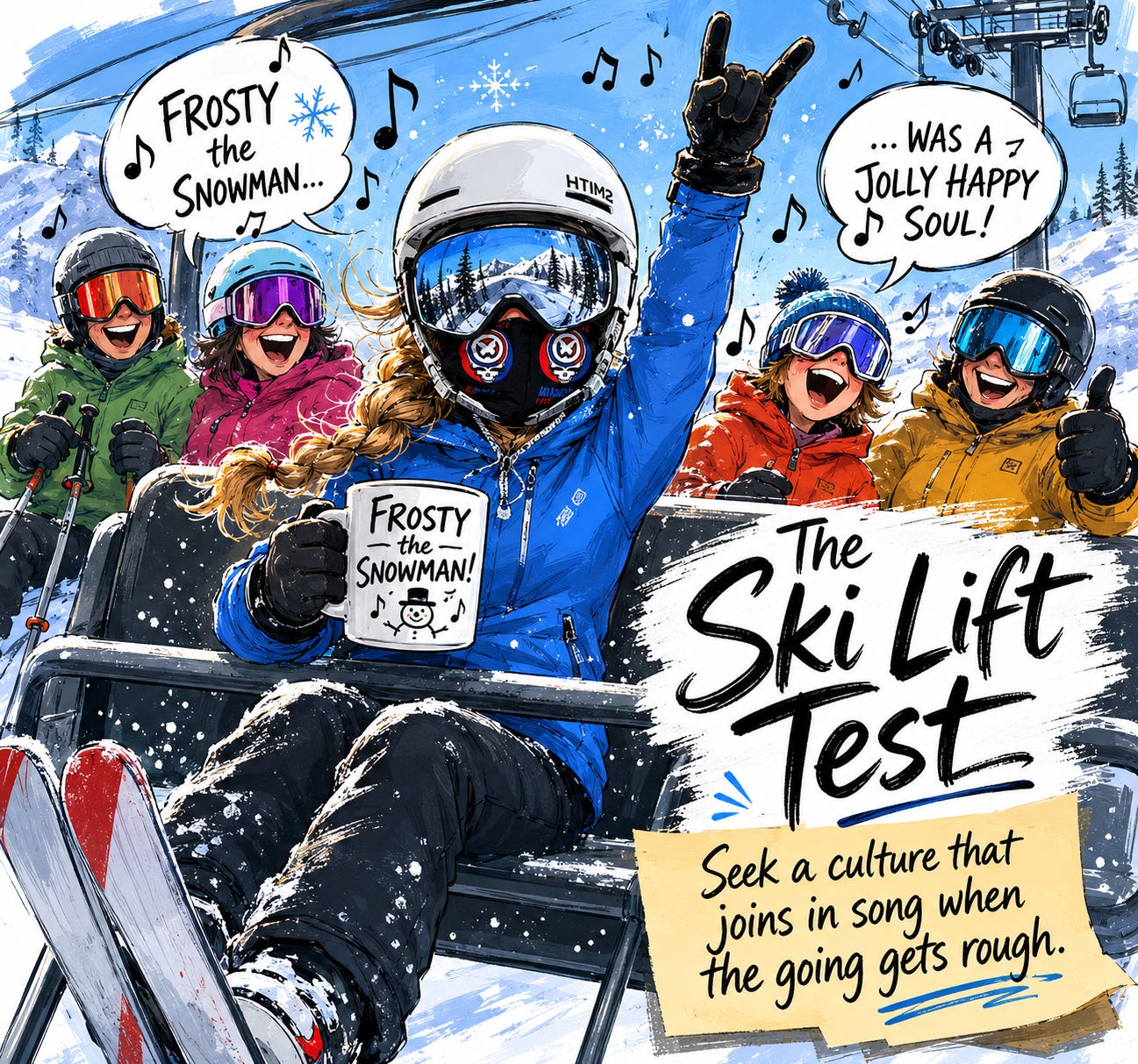
It feels a little strange to write about skiing while everyone else is posting photos of hot dogs and patio cocktails for Memorial Day weekend, but I was trying to explain something about culture to a physician friend of mine recently, and this memory popped up, so I’ll pass it on.
Two winters ago, I was skiing at Monarch Mountain on one of those Colorado afternoons where the mountain turns on you a little as the sun goes down. The light gets flatter as the day goes on, and the snow gets heavier and slicker. The wind starts finding every zipper and glove seam you thought was doing its job, and you start bargaining with yourself about whether one more run is actually a good idea.
The temperature had dropped hard. The wind chill was around five degrees. Everyone on the lift had the same look: of painful perseverance for one more run.
We were two chairs from the top when the whole lift stopped.
Nobody panicked because ski lifts stop all the time. Someone falls getting off, a kid drops a pole. You wait a minute or two, and things start moving again. Standard mountain inconvenience.
But the minutes stretched out. Five. Then eight. Then ten. The wind was not stopping, and everyone was doing that thing where you shift your weight and tuck your chin and try to convince yourself that your toes are probably fine even though you already know they are not.
And then, from the chair directly behind us, a kid, maybe 15 years old, started singing Frosty the Snowman. He was fully committed and belting it out.
A few people laughed. Then someone joined him. Then another, and within about two minutes, this entire line of freezing strangers hanging above a mountain was singing Christmas songs in unison like we had all agreed to this beforehand.
For two verses, nobody cared that we were stuck. Our toes were still somewhere on the wrong side of numb. Really, nothing about our circumstances had changed at all, except that one kid decided to reach for something human instead of retreating further into his own misery, and everyone else decided to meet him there.
I have thought about that moment a lot because I think it says something true about culture.
Culture gets described as an aspiration, something you build toward, something you display.
But culture is not what happens when things are easy. Culture is what people reach for when discomfort shows up. It is what fills the silence when the lift stops moving. And it is different in every organization. Some cultures default to blame, or it goes quiet and emotionally disappears, and everyone retreats to their individual seats and waits it out alone. Some move toward panic when the plan falls apart. And some, the ones that are genuinely worth joining, instinctively move toward each other.
The ski community has always fascinated me for this reason. Underneath all the equipment, the adrenaline, and the technical vocabulary, there is this unspoken current of shared humanity running through it. People cheer for strangers on hard runs. They help each other up without being asked. They laugh when the conditions are rough. They tell real stories on lifts with people they will never see again. There is fear and exhaustion and challenge and joy all mixed together, and somehow people are fully present inside all of it.
That is what I think about when I think about the culture we are building at ReflectionPoint Advisors. I want a culture where people feel safe enough to stay human when things get hard. Where our team and our clients can stretch their thinking, do meaningful work, and still find genuine moments of levity in the middle of the difficult parts.
Because every company eventually hits weather. Every team has a season where the lift stops, and the wind is coming from every direction, and the timeline for getting moving again is genuinely unclear.
The question worth asking, before you take the job, is what this particular group of people reaches for when that happens.
Which is why I encourage the leaders we work with to stop asking “what’s the culture like here?” in interviews. Nobody answers that question honestly. They will describe the culture they aspire to, and that description might be entirely sincere and still tell you almost nothing about what Tuesday at 10:47 pm actually feels like when something goes wrong.
The questions that reveal real culture ask about behavior under pressure. Here are ten worth carrying into your next conversation.
1. Ask what tends to create the most stress on the team, and then ask what usually happens relationally when that stress shows up. The first part identifies the pressure point. The second part tells you whether the team holds together or fractures when they hit it.
2. Ask them to tell you about a recent project that did not go as planned, and then ask how the team responded internally. Listen for whether they make real decisions together. A culture that handles failure well almost always tells stories about it that involve humans, not just process.
3. Ask what burnout tends to look like there, and how leadership usually responds when they see it. This reveals whether leadership treats burnout as an individual problem or an organizational signal, which tells you a great deal about how much of yourself you are allowed to bring to the work.
4. Ask what kind of employee tends to thrive, and what kind tends to struggle. The thriving profile will come easily. The struggling profile is the one worth sitting with, because that is usually where the actual culture lives.
5. Ask what happens when someone disagrees with leadership, and ask for a specific example. If they cannot give you one, that is already an answer.
6. Ask how sudden priority changes are communicated, and how teams usually absorb the impact. How a company handles the gap between the decision and the people most affected by it tells you almost everything about respect.
7. Ask what employees tend to joke about internally, and what the interviewer thinks that says about the company. Humor in organizations is almost always about pain that is not being officially addressed. What people make jokes about is a map of what is true.
8. Ask what happens when someone makes a mistake, and what accountability looks like in practice. There is a version of accountability that is growth-oriented and human. There is another version that is punitive and political. You need to know which one you are walking into before it is your mistake.
9. Ask about a recent hard season the company has been through, and what brought people together during it. If they cannot name a hard season, they are not being honest with you. If they can name it and describe something real about how people showed up for each other, you are probably talking to someone who will be honest with you when the next hard season arrives.
10. And ask them, if you spoke to someone who left the company in the last year, what that person would probably say the culture feels like. How someone answers a question about how they might be perceived by someone who has moved on tells you an enormous amount about how much self-awareness lives in the room.
You are not just interviewing for a role. You are interviewing for the environment where you will spend most of your waking hours, and for the people who will be in the room with you when the project fails.
One day, the lift is going to stop somewhere in your career. The wind will be cold, the conditions will be uncomfortable, and the timeline for getting moving again will not be clear.
I hope you are surrounded by people who know the words to Frosty the Snowman.
And I hope somebody actually starts singing.
Let’s find your next adventure:
#WorkWorthDoing #ClarityForWhatsNext #ReflectionPoint #Leadership #ExecutiveSearch #CareerClarity #Culture #Hiring #SeniorLeaders #FutureOfWork