There is a pattern I have watched play out more times than I can count, and it almost never gets talked about honestly.
The people who struggle most in transition are not the ones who lack ability. They are not the ones who failed to work hard or build something real. More often than not, the people who struggle most are the ones who have been the most successful, because success, over time, quietly builds a belief system that can be very hard to recognize and move past gracefully.
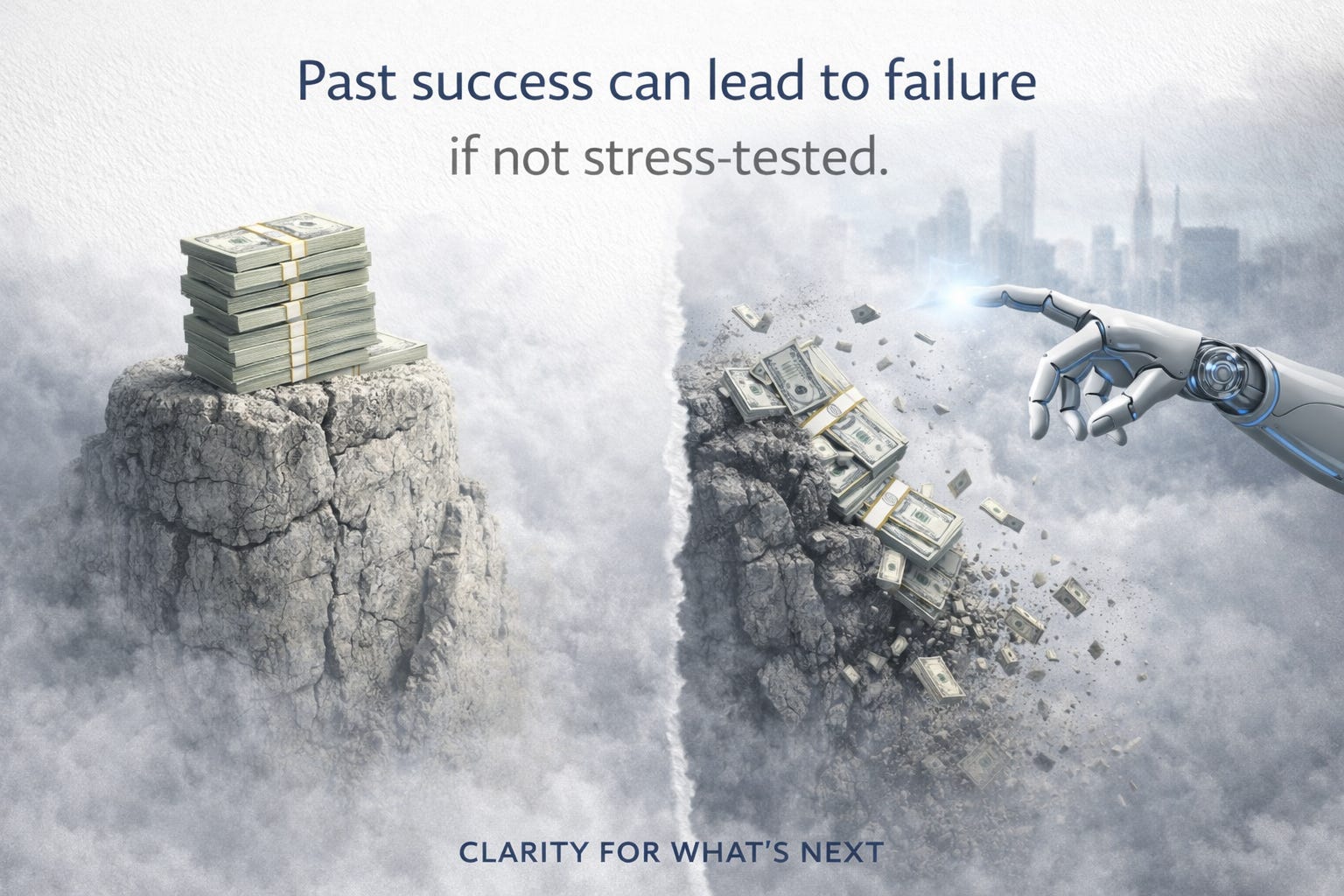
When things have worked for you, you learn a set of truths: stay the course, keep showing up, trust what got you here. And those truths are not wrong. They are just incomplete. Because success in one environment does not guarantee success in the next one, and the longer things have worked for you, the more invisible it becomes when they stop.
This has always been true. But right now, in 2026, it is more consequential than it has ever been, because the environment itself is changing faster than most people’s belief systems can keep up with.
The Hidden Cost of Winning
Here is what past success actually teaches you, whether you realize it or not.
It teaches you that persistence is the answer. That consistency will eventually be rewarded.That if you have done something well before, you can do it again the same way. And for a long time in the world of work, those lessons hold. But environments are changing, and markets are shifting, and what was relevant last week has been lapped and replaced.
When people who evaluate you change their criteria, and what used to be a signal becomes noise, it is sincerely not because you got worse, but because the context around you has moved while you were still operating from the old map.
We are in the middle of the most significant professional context shift in a generation. AI is not coming — it is here, and it is actively reshaping what competence looks like, how value gets evaluated, and what skills command attention and compensation.
The playbook that worked three years ago is not just slightly outdated. In many cases, it is functionally obsolete. The executives and founders who are struggling most right now are struggling because they are running an excellent version of a strategy that the market has quietly moved past.
Where This Breaks for Executives in Transition
Executives are not used to being unknown. Their entire professional experience has been built inside a world where they get referred, where their track record does the talking. When you walk into a room with their background, people lean forward.
Then they hit the open market, and something feels different. Conversations stall. Roles they are clearly qualified for do not convert. Feedback, when it comes at all, is vague. And so they do what has always worked: they tighten the resume, refine the language, apply to more roles, and wait for the right opportunity to come together.
But here is what they are not accounting for: the hiring process itself has fundamentally changed. AI is now screening resumes before human eyes ever see them, not just for keywords but for coherence, scope alignment, and narrative precision. Hiring teams are using AI tools to research candidates more deeply and faster than ever before. And the leaders on the other side of the table are thinking carefully about whether the person in front of them understands the world they are actually walking into — a world where AI literacy is no longer a differentiator, it is a baseline expectation.
The market rewards clarity, and increasingly, it rewards demonstrated awareness of where things are going, not just where they have been. If your value is not immediately legible to the people evaluating you, no one is going to do the interpretive work on your behalf. The problem is rarely the resume itself. It is the framework behind the resume, and whether that framework reflects the present moment or a version of the market that no longer exists.
Where This Breaks for Founders and Business Owners
Founders experience the same dynamic in a different form. The first time around, things worked because of a combination of factors: timing, network alignment, market conditions pulling you forward, and real execution ability. But it can be genuinely difficult to know which of those factors was doing the most work, because when something succeeds, it validates everything at once.
So when things slow down, the instinct is to double down. More time, more consistency, push through this phase. But the businesses that are struggling right now are struggling because of execution failures. Many of them are struggling because their model, their messaging, or their go-to-market approach was built for a buyer that AI has fundamentally changed. The way people research, evaluate, and decide has shifted. The threshold for what counts as expertise has shifted. Even the competitive landscape has shifted, because AI has dramatically lowered the cost of entry in almost every category.
Doubling down on what worked before, in this environment, is not discipline. It is denial wearing the costume of persistence.
The Real Risk: False Confidence
This is the part that rarely gets named directly. Past success does not just give you confidence; it can give you false confidence, a kind of certainty that delays the moment when you ask the harder question. Is this still working? Is this approach still relevant? Am I actually playing the same game that I think I am?
What Actually Needs to Happen
The best operators, whether in career transition or building a business, are not necessarily the ones who work hardest. They are the ones who recalibrate fastest.
They treat past wins as data, not destiny. What worked then is a useful reference point, not proof that the current approach is right. They ask, with real curiosity and no defensiveness: does this still apply? They build course correction into the process before something breaks, not as a last resort after it already has. And they engage honestly with the world as it actually is right now.
The leaders who are winning in the AI age have figured out how to bump and jive amid the shift. They are the ones who got clear on what it means for them specifically, updated their positioning and their strategy accordingly, and moved quickly, cleanly, and without waiting for the crisis to force their hand.
This is a discipline that runs against everything high performers are taught. Most people in this position have been rewarded their whole careers for pushing through.
Why This Is Exactly Why RPA Exists
Most solutions to this problem are tactical. Better resume, better messaging, more outreach. And those things matter, but they are downstream of something more fundamental.
What happens on the battlefield of our minds directly translates into our actions, decisions, and behaviors. If your thinking is anchored in a past version of success, one that predates what AI has done to hiring, to business evaluation, to professional positioning, your strategy will always lag behind your potential, no matter how polished the execution looks on the surface.
At ReflectionPoint Advisors, we work at that level first. Before we touch positioning or narrative or outreach or pipeline, we get clear on what game you are actually in right now, in this market, with these conditions.
We look at where you create the most value given how the landscape has actually shifted — not how it looked two or three years ago. And we build a strategy from that clarity, because once it exists, everything else moves faster and with far less friction.
The Bottom Line
Past success is not the problem. Relying on it as a substitute for current clarity is.
If things feel harder than they should right now, pay attention to that. That friction is not random. It is information. It is telling you that the environment has moved and that your approach may not have moved with it, and that, in a world moving this fast, the gap between the two closes quickly.
That is not a reason for discouragement. It is a Reflection Point.
And Reflection Points, handled well, are where the best next chapters begin.
#WorkWorthDoing #ClarityForWhatsNext #ExecutiveSearch #Founders #CareerIntelligence #FutureOfWork