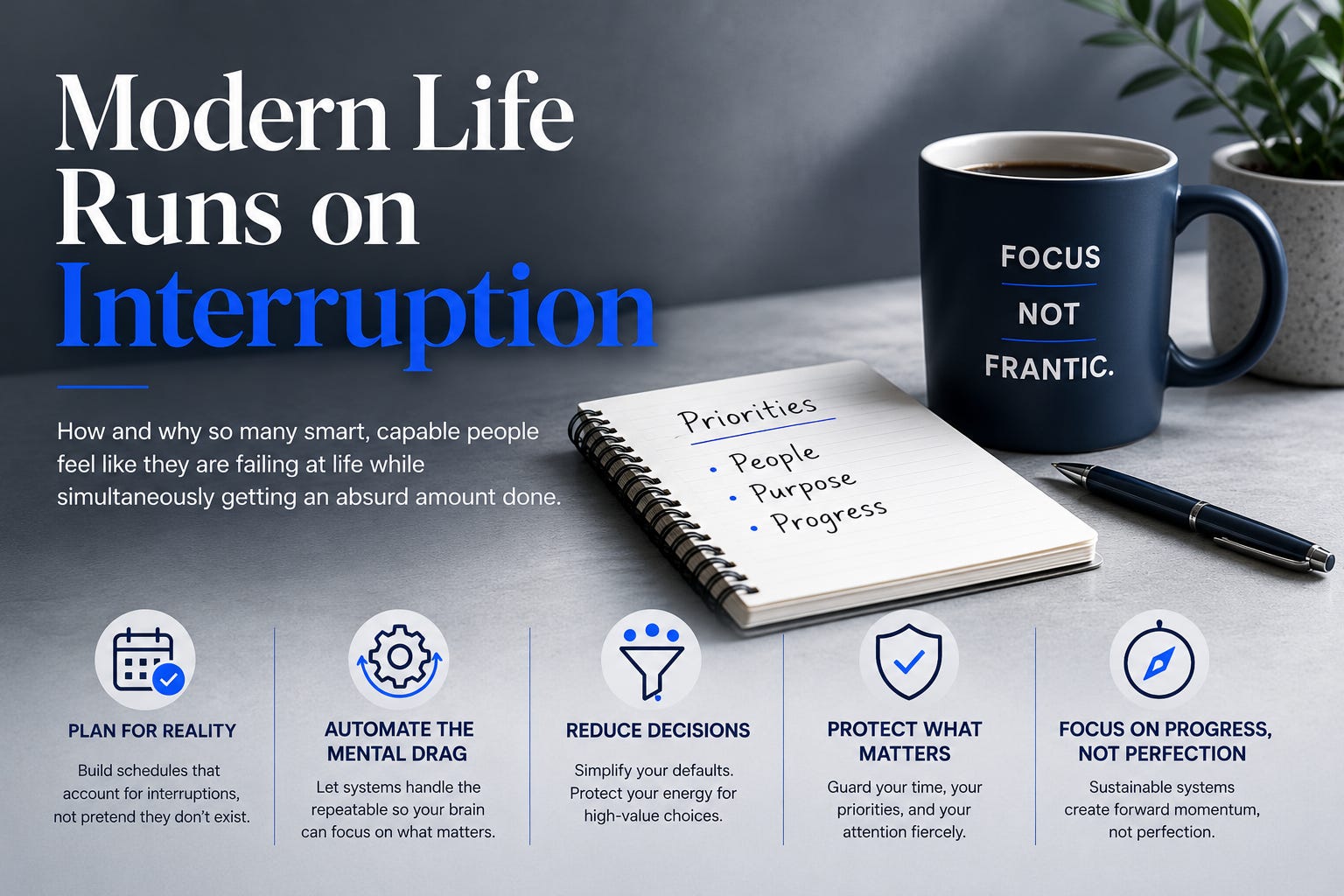
How and why so many smart, capable people feel like they are failing at life while simultaneously getting an absurd amount done
I have a theory.
Most productivity advice was built for a version of adulthood that no longer exists. A quieter one where email was checked a few times a day instead of inhaled continuously through your nervous system, and “urgent” did not include Slack messages, school alerts, breaking news, prescription refill reminders, five open browser tabs about retirement planning, and a dog suddenly needing orthopedic surgery.
The systems we were taught were built around predictability and friends; in this modern version of life, we are running on interruptions. And I think a lot of incredibly capable people are quietly walking around believing they are bad at time management when the truth is much more interesting than that.
The operating system changed. Nobody warned us.
The old productivity fantasy looked like this: wake up early, exercise, journal, answer email, do deep work, eat a healthy lunch, have a focused afternoon, sit down to a real family dinner, read ten pages of something meaningful, sleep eight hours. Beautiful concept. Really inspiring and probably still true in a Scandinavian documentary.
Now let me show you my Monday.
Wake up (I did that right today). My alarm, which is set to the new Noah Kahan, Great Divide, goes off at 6 am. I am up! Check.
I am feeling anxious, not because anything has gone wrong, but because my brain spent the hours of 10 p.m. - 12 a.m. running dress rehearsals for conversations that have not happened and may never happen.
The news was, as it has been for some time now, psychologically corrosive before 8:30 am. And somewhere in the middle of all of this, people were still forwarding me podcasts about optimizing my morning routine.
Respectfully, I think we need a new framework.
Because the people staying effective (which I am striving to become) right now are not necessarily more disciplined. They just learned to organize their lives around reality rather than fantasy. That is the real skill now. It’s all about not pretending you have the emotional bandwidth of a small Nordic nation. Just reality-based effectiveness.
What the strongest professionals actually do differently
The people I know who are genuinely holding it together, the ones doing good work without constantly running on empty, have a few things in common. None of it is glamorous. All of it seems to me to work - at least better than my current hustle.
They reduce decisions aggressively. They eat healthy breakfasts. They block their calendars for the work that matters and protect those blocks as they would a flight. They automate small choices because they understand something that most advice columns skip: adults with complicated lives do not live up to their intentions. They fall to the level of their systems.
Which brings me to something I think more people need to hear. Automation is no longer just a business strategy. It is a life strategy. Not in some dystopian “let an algorithm run your existence” way. I mean, in a very practical “stop spending precious cognitive energy on the same fifteen tasks every week” way.
The people staying sane right now are quietly automating parts of their lives that used to create constant mental drag, and they are not talking about it because it sounds unglamorous. It is unglamorous. It is also one of the most effective things you can do.
Stop using your brain as a reminder app. Most people are carrying around dozens of tiny unfinished loops: schedule the dentist, refill the prescription, pay quarterly taxes, order dog food, email the teacher back, replace the air filter, text your brother. That mental clutter is exhausting in a way that is hard to quantify because it does not feel like work. But it costs you every hour of every day. A simple recurring task system gets those loops out of your head and into a structure that runs without you. The point is not to become a more organized person. The point is to stop asking your brain to babysit forty unfinished things while also trying to think creatively.
Stop manually moving information between systems.
A shocking amount of adult exhaustion comes from copying things from one place to another. Download this, upload that, forward this, add that to the calendar, turn that email into a task. This kind of repetitive friction is a solved problem that millions of people are still solving manually every day. You do not need to know how to code. You just need to decide that your attention is not free and stop treating it as if it were. RPA can teach you how to use tools like Claude Cowork or other AI support tools to make these manual data tasks a thing of the past.
Build default days and actually use them.
This is the most underrated productivity idea I know. Highly effective people do not reinvent their entire lives every morning. They pre-decide parts of them. Monday is meetings. Tuesday morning is deep work. Friday is finances and logistics. Sunday evening is reset. Structure is not the enemy of creativity. It is the container that makes creativity possible. The older I get, the more I think chaos masquerades as freedom in American culture, and people pay a real price for believing it.
Automate your recovery with the same seriousness you automate your work.
This is the one almost nobody does. People will automate pipelines, calendars, CRMs, and reporting dashboards, and then completely improvise sleep, movement, rest, and food. Which is genuinely strange when you consider that those things power everything else. Automate grocery delivery. Schedule walks on your calendar like meetings. Block no-meeting hours and hold them, and set a recurring reminder to eat lunch if that is what it takes. Burnout is not impressive anymore.
The thing most people are actually drowning in
Most exhaustion is not coming from the workload, but from fragmentation and frustration. The average person now lives in a constant context switching: email, text, meeting, Slack, calendar alert, school app, news notification, forgotten task, half-finished thought, and another meeting. That is not a heavy day, but rather a fractured one. And fractured days are more exhausting than heavy ones because you never get the satisfaction of real forward movement. You are always starting and rarely finishing.
Most people are not drowning in too much work. They are drowning in too many interruptions while working. Microsoft’s 2025 Work Trend Index found that employees in structured arrangements with clear expectations reported 23% higher focus scores than those in unstructured setups. The word that matters there is structured. Not chaos-free, but structured enough that you know when deep work happens, and you actually protect it.
Highly effective people used to ask, “How do I do everything?” The healthier question now is what actually matters TODAY?
That is building a life that can survive reality. Studies show a 35% to 40% increase in productivity among remote workers, driven not by longer hours but by better focus. The output increases when attention is protected. The people doing well right now are people who stopped expecting themselves to function like machines while carrying a very human life. And once people stop fighting reality, they almost always get better at navigating it.
This is the work we think about at ReflectionPoint Advisors. The whole picture of how high-performing people sustain themselves through a world that was not designed to make it easy. If you are in a season where the work is piling up, and life is piling up faster, the answer is not to work harder. The answer is to get clearer ABOUT what matters. About what to protect. About what to finally let the systems handle.
Clarity for what is next starts here.
#WorkWorthDoing #ClarityForWhatsNext #ReflectionPoint #Productivity #Leadership #WorkFromHome #FutureOfWork #CareerClarity #MentalHealth #SeniorLeaders
ReflectionPoint Advisors
· Recognition · Insight · Clarity · Action ·
http://reflectionpointadvisors.com/clarity-call?src=substack