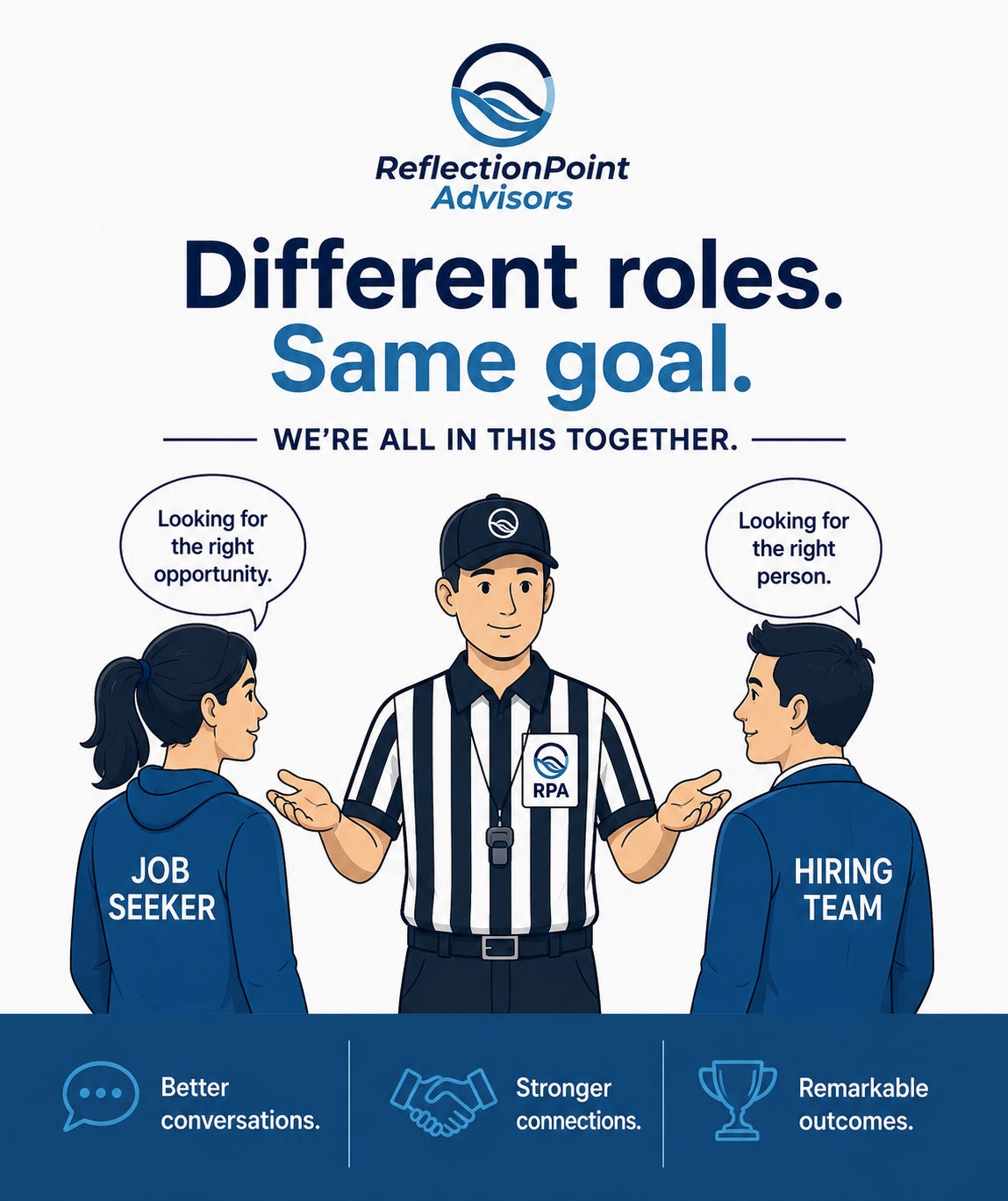
On Friday night, at about 3 am, I had one of those sit-up-straight moments. My head was telling me that the hiring game has turned into a Cold War, and that it is vital to reach out to our community and remind them: we are all in this together. So, unpacking it: what needs to be addressed to keep the hiring managers from losing their minds and the candidate from feeling unheard?
The recruiters screening resumes at 9:14 pm on a Tuesday aren’t pontificating about the font you chose. They are juggling forty open requisitions, three hiring managers who all believe their role is the highest priority in the building, an applicant tracking system that feels like it was designed with limited filtering by today’s standards - it’s all too much.
On the other end, candidates are rocking out their 200th application, according to 2026 data tracking actual job-seeker behavior. They have optimized their resume so many times that they no longer fully recognize themselves in it. They are trying to stay emotionally functional while hearing nothing back from companies after spending a lot of time preparing for that virtual interview. And the silence persists as their entire near-term future hinges on getting a job.
My take: candidates are facing financial pressure and wasted time, combined with poor timeline planning and a lack of forward communication during the screening process, which is hurting their health and making them show up a little less than perfect to the next interview.
Sixty-one percent of candidates were ghosted after an interview in 2026, up nine points from the prior year. Not after a cold application into a void. After an interview. After investing real time and genuine effort, a thank-you note was sent the same day.
Nobody in this system is having a good time.
And yet from the outside it looks like a competition. The candidate is trying to break through. The company is running a defense. The recruiter becomes the gatekeeper. The ATS becomes the villain. Everyone starts assuming bad intent where there is usually just operational exhaustion, and the process that was supposed to connect the right people starts feeling adversarial instead.
I do not think most of this is a people problem. I think it is a systems problem wearing a people costume.
Thing of this: thirty-five percent of recruiters’ time is spent on interview scheduling alone. Not a candidate evaluation. Not relationship building. Not strategic sourcing. Calendar Tetris. Trying to get six humans into the same forty-five-minute window before someone leaves for Cabo. If you have ever waited two weeks for a first conversation and wondered what could possibly be taking this long, that is your answer.
At the exact same moment candidates needed more clarity about where they stood, most hiring teams became less equipped to provide it. Budgets got cut, teams got smaller, and communication expectations went up while human bandwidth went down. The average time to hire in 2026 is forty-one to forty-four days, and top candidates are typically only available on the market for ten days. That structural mismatch is not anyone’s fault. It is genuinely badly organized. And the person living on the receiving end of it is simultaneously managing a mortgage, health insurance, tuition, family expectations, their confidence, and their sense of professional identity while waiting for a process they have no or limited visibility into.
The sports metaphor I keep coming back to is a game where both teams are technically working toward the same outcome, a hire that actually works, a person in the right seat, an organization that moves forward, but they are running completely different playbooks with different clocks and no shared scoreboard. The offense thinks the defense is stalling. The defense thinks the offense has no idea what is happening on their side. Both are frustrated. Both are tired. Neither is cheating. The game is just badly designed.
Brene Brown wrote something that should honestly be printed on the wall of every recruiting department in America. In Dare to Lead, she wrote: “Clear is kind. Unclear is unkind.” She was writing about feedback, but it applies to hiring with almost surgical precision. A timeline communicated is kind. A clear next step is kind. A prompt rejection, even a brief one, is kind. Silence is not neutral. It costs people something real, and most hiring teams never fully account for that cost because they do not see it from where they are sitting.
Only eleven percent of organizations check candidate satisfaction after the process ends. Which means 89% of hiring teams are running a process that affects real people’s lives and careers without ever asking how those people feel going through it. Somewhere down the line, efficiency became louder than humanity.
Here is what good communication actually asks of both sides, and neither request is unreasonable.
For candidates, ask about the timeline early and ask specifically. Not “what does the process look like” in a vague way, but something direct: what are the next steps from here, when should I expect to hear back, and is there anything I can do to help move things forward on my end? That is not pushy. That is professional. It creates a small shared commitment to a timeline and makes follow-up feel natural rather than anxious. The strongest candidates do not disappear politely into uncertainty, hoping someone remembers them. They create the clarity they need when the process is not providing it.
For hiring teams, the highest-leverage thing available is also the simplest. One sentence at the end of every interview: “We expect to complete first rounds by the end of next week and will follow up either way.” That takes thirty seconds to say and changes the entire emotional experience a candidate has with your company. People remember how uncertainty felt. They remember whether they were treated like a transaction or a person. They remember whether the organization seemed organized and decent, even when they did not get the job. Especially then. Research shows that cutting just five days from the interview stage improves candidate satisfaction scores by twenty percent. Not an overhaul. Five days and a sentence.
At ReflectionPoint Advisors, this is real work we do with the people we support. Not just interview answers and resume language, but how to ask better questions, how to create actual dialogue in a process designed for evaluation, how to show up as a professional having a conversation rather than a candidate performing for a panel. Because the best hiring processes never feel adversarial. They feel like two sides of the same table, finally working from the same playbook.
The offense and the defense were never supposed to be enemies. They were supposed to build the same team.
Maya Angelou spent a lifetime saying something that applies here more than it might seem: “We are more alike, my friends, than we are unalike.”
Don’t forget: the recruiter sending the difficult email and the candidate refreshing their inbox for the seventh time that morning are both just people trying to get something important right. Both are carrying more than the process gives them credit for. Both are more human than the system allows. Better communication will not fix every structural problem in hiring. But it will absolutely change how people feel as they walk through it. And in a process this emotionally loaded, that is a meaningful improvement
#WorkWorthDoing #ClarityForWhatsNext #ReflectionPoint #Hiring #CareerClarity #Recruiting #Leadership #ExecutiveSearch #FutureOfWork #JobSearch